

With just a few consistent and shockingly simple weight loss tips, Pat was able to lose 44 pounds, cut his visceral fat by more than half, and transform his body composition — all while maintaining a busy work schedule. Here’s exactly how he did it.
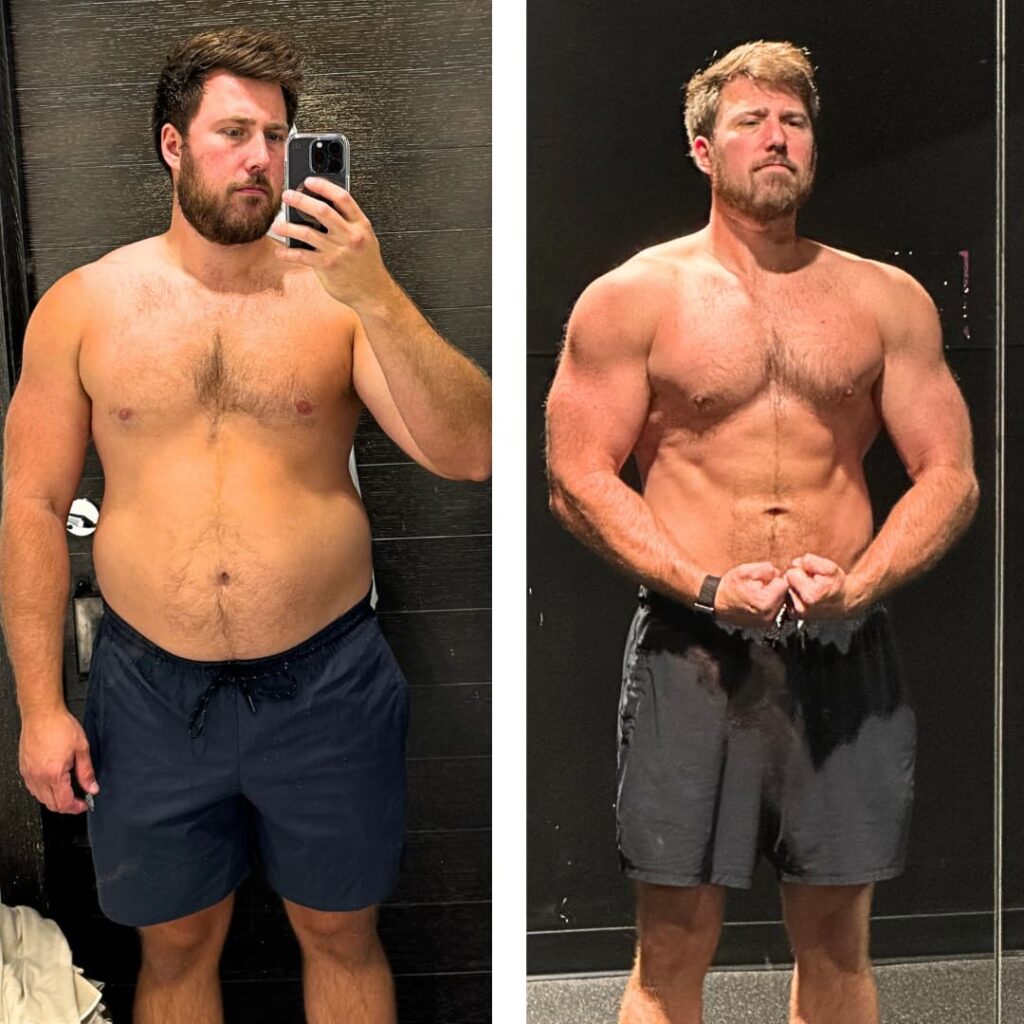
Recently I was able to interview my good friend, Pat. Over the last 18 months he’s been chipping away at a complete body and life transformation. With a few simple tools done consistently, he lost 40 pounds of pure body fat and more than half of his visceral fat.
You can checkout his inspiring interview with the video below. Scroll down for the highlights and science-backed evidence for his top tips.
Pat’s Weight Loss Results
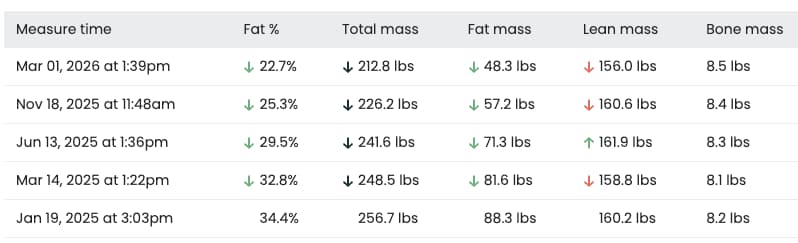
From the start of his journey, Pat started taking DEXA scans. This is a type of low radiation x-ray that accurately tells you your body fat, muscle mass, bone mass and visceral fat.
Here’s where Pat started on January 19, 2025:
- 256.7 pounds
- 34.4% body fat (this technically put him in the “obese” category)
- 88.3 pounds fat
- 160.2 pounds lean mass (like muscle)
- 8.2 pounds bone
His most recent results as of March 1, 2026:
- 212.8 pounds (43.9 pounds lost)
- 22.7% body fat (this puts him in a healthy body fat range!)
- 48.3 pounds fat (40 pounds of pure fat lost!)
- 156.0 pounds lean mass (only 9.5% muscle loss!)
- 8.5 pounds bone mass (this actually went up!)
The most shocking result was the change to his visceral fat. High levels of visceral fat can substantially increase the risk of nearly every chronic disease, including heart disease and type 2 diabetes. Pat started at 4.3 pounds of visceral fat which put him in the top 97% range for his age group. This means he had more visceral fat than 97% of men his age — not a good thing.
But his latest results showed that he has cut his visceral fat by more than half. He’s now at 1.8 pounds visceral fat — that’s 2.5 pounds of dangerous belly fat gone.
After just 14 months, he utterly transformed his body composition, health, energy and future. And the tools he used were shockingly simple. Let’s dive into those.
1. Taking Walking As Seriously As A Workout Routine
Pat was pretty consistent about hitting the gym, but one thing he didn’t take as seriously previously was getting his steps in.
“In my mind I was like, there’s no way this is going to work or make a difference, and lo and behold it did”.
This was the first step (pun intended) he made in his weight loss journey and that started to actually make a difference. He first aimed for 8,000 steps per day, then upped it to 10,000 and eventually set the goal for 12,000 steps per day. Now, 18 months later he averages about 10,000 steps per day.
The science that backs this up: Every time you move, including walk, your muscles are working. When your muscles flex, they soak up glucose from your blood, which lowers how much insulin (storing hormone) you have to release. When insulin is high, it shuts off fat burning. So by lowering insulin (such as through daily walking), it can allow the body to get back to fat burning faster. Even just a 30 minute walk per day has been shown to make significant impacts on a weight loss goal.
Related: 100 Mile Walking Challenge (Free Calendar Download)

2. Do What You Can Sustain
In the past, Pat had tried a bunch of short term quick-fixes, like P90x. And those were fine and gave him some results, but it was never something he could sustain (nor were they designed to be). So inevitably he would fall back into old habits and regain what he lost.
This time, he decided to do things a bit different. Anything he added into his routine he thought carefully about — is this something I can see myself doing for life? If so, then he would add it in. As a result, he slowly built in habits that sustainably got him to his goal and allowed him to maintain it.
The science that backs this up: Not only do researchers agree that small changes made over time result in more consistent, lasting results — it also leads to better body composition. This means people who slowly implement change tend to burn more body fat and keep more muscle, putting them in a better place metabolically, too.

3. Eat Protein, But Don’t Skip Fiber
From the start, Pat made sure to load up on protein because he didn’t want to lose a lot of muscle while burning fat — and that worked. Throughout his entire weight loss journey, he lost 91% of the weight from pure fat, not muscle. To put this into perspective, most weight loss protocols expect people to lose about 20% of their weight from muscle, with interventions like GLP-1 medications being as high as 40% from muscle.
So, protein = very important.
Related: Free Protein Calculator (Find out how much you need to eat!)
After only focusing on protein and ignoring everything else, Pat started to stall. So after doing some research and having a quick chat with me one day at a friend’s BBQ, Pat learned he needed way more fiber.
He didn’t drastically change his meals. He just started adding in a few high fiber foods to what he was already doing — some chia seeds to his protein smoothie and broccoli to dinners. This is when everything really started to change.
“Fiber alone was the most shocking. Immediately within a week, I was like this is working so well.”
The science that backs this up: Fiber stretches the stomach, which signals to the brain that you’re full and don’t need to keep eating. When you up your fiber, it helps shut off cravings and “food noise” because you aren’t as hungry. Protein also does this, but through a different mechanism (hormones) and takes about 30 minutes to kick in. Fiber works faster and helps to fill the time gap so that you feel full immediately after your meal (and avoid snacking) while you wait for protein to do the long term fullness work.
If you’re looking for ways to easily up your fiber, you can grab my free High Fiber Food List download. Print this out and keep it on your fridge for an easy high fiber reference.
Related: High Fiber Food List Download
4. Focus On Reducing Hunger, Not Calories
Pat initially focused on protein and a slight calorie reduction, which he did make progress, but then he “hit a wall”. Rather than just trying to eat even less, he did something that most people would find counterintuitive — he added more. Specifically, fiber. As you saw in the last tip, this is when things really accelerated for him. And what’s wild is he was significantly less hungry and things felt more do-able.
“You can still manage your macros, but I think it was managing hunger that I never did before. And now that’s when I really started to notice, okay, I’m losing more than a pound a month now. It’s two, three, and it started to build. All while being sustainable. I still to this day maintain these habits and it’s been over 18 months now. And I think all together that’s what really moved the needle for me.”
The science that backs this up: When you just focus on calories, you get hungry. And there’s only so long you can feel hungry before your body tells you to eat… which then can lead to binging. But by telling your brain that you’re full through protein and fiber, you can shut down this restrict and binge cycle, resulting in sustainable, lasting fat loss.

5. Eat Healthy Carbs At Dinner
For a long time, Pat avoided all carbs. And again, this worked… until it didn’t. Suddenly he was extremely tired all the time, he wasn’t recovering well from his workouts, and his sleep was suffering. So he started to add in some healthy carbs — strategically at dinner.
And it worked!
Suddenly his sleep improved, he felt more energized, his mood improved, and he was seeing progress in the gym again — which further fueled his fat loss journey.
The science behind this: Carbs at dinner help to lower the stress hormone cortisol. When cortisol is low it also allows your sleep hormone melatonin to go up, resulting in deeper, higher quality sleep. Plus, some carbs are important for recovering muscles post-exercise. But it’s important to keep it balanced. Too many carbs can cause a blood sugar crash and wake you up throughout the night, resulting in worse sleep. Using high quality starches, like beans, lentils, and sweet potato, can help you to get better sleep while still working toward a weight loss goal.
A good rule of thumb for fat loss is to focus on low to medium glycemic load carbs. These are the ones that provide fuel without a huge blood sugar spike.
Related: Glycemic Load Food List
Final Thoughts
Pat’s story is very similar to the multitude of men and women I’ve interviewed on my blog and channel. Regardless of their different starting points or previous struggles, they all have something in common — they didn’t focus on a quick fix, rather something that they can do for life.
The results might be a bit slower than if you drastically cut your calories and started running 10 miles a day, but they’re ones that can be maintained so that you can feel great for life, not just for 30 days.
If you’re looking for step-by-step tools and a meal plan to support your journey, check out our Body Recomposition Program. This meal plan uses similar protein and fiber tools that Pat focused on to prioritize fat burning while keeping muscle.
Science-backed + sustainable
The Body Recomposition
Meal Plan
Look leaner and feel your best with 6 weeks of simple, structured meals. Enjoy delicious, real-food recipes designed to support fat loss and muscle retention — without tracking, restriction, or complicated prep.
Studies
Slow Weight Loss vs Fast Weight Loss on Body Composition